Introduction
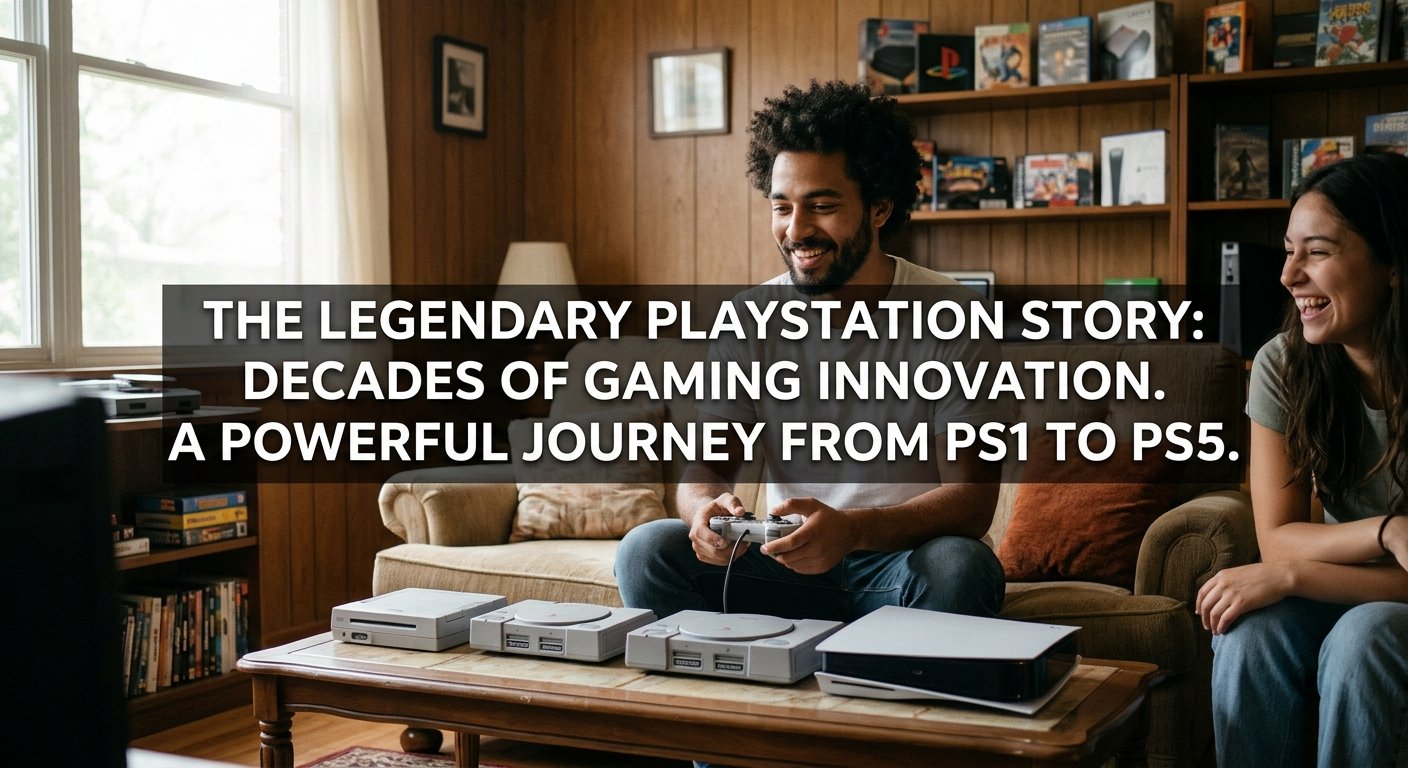
The gaming industry has experienced remarkable changes over the past few decades. From simple arcade machines and traditional home consoles to powerful gaming systems with realistic graphics and online features, technology has completely transformed the way people play video games. Among the companies responsible for this development, Sony has played one of the most important roles through its popular PlayStation brand.
PlayStation has become one of the most recognizable names in the gaming world. It introduced millions of players to unforgettable gaming experiences, advanced console technology, iconic controllers, and some of the most successful video game franchises in history.
Since the release of the original PlayStation in 1994, Sony has continued to develop new generations of gaming consoles. Each generation has introduced improvements in processing power, graphics, storage, online connectivity, controller technology, and entertainment features.
Today, PlayStation represents much more than a gaming console. It is a complete gaming ecosystem that includes home consoles, digital services, accessories, virtual reality technology, and a large collection of games.
In this article, we will explore the history and development of PlayStation, including its beginnings, major console generations, technological improvements, popular games, and future possibilities.
1. The Beginning of PlayStation
The history of PlayStation began before the original console was released. During the early 1990s, Sony became interested in entering the video game industry and developing new entertainment technology.
One important figure in this development was Ken Kutaragi, a Sony engineer who became closely associated with the creation of PlayStation.
Sony had previously worked on a project involving a CD-based gaming system with Nintendo. However, the proposed partnership did not develop into the commercial product originally planned. Sony eventually decided to move forward with its own gaming platform.
In November 1993, Sony Computer Entertainment was established as a joint venture involving Sony Corporation and Sony Music Entertainment Japan. This organization helped prepare the company for its entry into the gaming market.
The original PlayStation was officially launched in Japan on December 3, 1994. It later arrived in North America and Europe in September 1995.
The console introduced a new approach to home gaming through its use of CD-ROM technology and real-time 3D graphics. It quickly became a major competitor in the gaming industry and helped establish Sony as an important gaming company.
2. Original PlayStation (PS1)
The original PlayStation, commonly known as PS1 or PSX, was the console that introduced the PlayStation brand to the world.
<escape>### </escape>Release Information
- Japanese release: December 3, 1994
- North American release: September 9, 1995
- European release: September 29, 1995
The original PlayStation was designed to provide more advanced gaming experiences than many traditional cartridge-based systems of its time.
One of its most important features was CD-ROM support. CDs offered greater storage capacity than many commonly used game cartridges, allowing developers to include more detailed environments, music, voice recordings, and full-motion video.
The console also introduced powerful 3D graphics capabilities that helped developers create more complex game worlds.
Its controller introduced the familiar directional buttons and four iconic action symbols: Triangle, Circle, Cross, and Square.
Later, Sony introduced controllers with analog sticks and vibration feedback, making movement and interaction more advanced.
Popular Games on the Original PlayStation
Some of the most memorable games released for the original PlayStation included:
- Crash Bandicoot
- Gran Turismo
- Tekken 3
- Resident Evil
- Final Fantasy VII
- Metal Gear Solid
- Tomb Raider
- Spyro the Dragon
These games helped establish several successful franchises and attracted players from different gaming communities.
The original PlayStation became a major success, with more than 100 million units shipped worldwide. It helped change the direction of the gaming industry and created the foundation for future PlayStation generations.
3. PlayStation 2 (PS2)
After the success of the original PlayStation, Sony introduced the PlayStation 2 in 2000.
<escape>### </escape>Release Information
- Japanese release: March 4, 2000
- North American release: October 26, 2000
- European release: November 24, 2000
The PlayStation 2 represented a major improvement in console technology. It introduced more powerful hardware, improved graphics, and a wider range of entertainment features.
One of its most important features was DVD playback. Players could use the console not only for video games but also to watch DVD movies.
This made the PS2 attractive to households that wanted a gaming system and a home entertainment device in one product.
The console also supported backward compatibility with many original PlayStation games, allowing users to continue enjoying their existing game collections.
Sony later introduced network adapters that enabled online multiplayer experiences in supported games.
Popular Games on PlayStation 2
The PS2 became famous for its extensive game library. Some of its most popular titles included:
- Grand Theft Auto: San Andreas
- God of War
- Shadow of the Colossus
- Metal Gear Solid 2
- Gran Turismo 4
- Resident Evil 4
- Final Fantasy X
- Devil May Cry
- Tekken 5
- Need for Speed: Most Wanted
These games demonstrated the console’s ability to support different genres, from action and adventure to racing and sports.
The PS2 became the best-selling home video game console in history, with more than 160 million units sold worldwide.
Its success established PlayStation as one of the strongest brands in the global gaming industry.
4. PlayStation 3 (PS3)
Sony introduced the PlayStation 3 in November 2006, bringing another major technological change to its console lineup.
<escape>### </escape>Release Information
- Japanese release: November 11, 2006
- North American release: November 17, 2006
- European release: March 23, 2007
The PlayStation 3 was designed to deliver high-definition gaming and advanced multimedia entertainment.
One of its most important features was Blu-ray Disc support. Blu-ray offered significantly greater storage capacity than DVDs, allowing developers to distribute larger games and high-quality multimedia content.
The PS3 also introduced the Cell Broadband Engine processor, which was designed to support demanding computing and graphics tasks.
Another major development was the PlayStation Network (PSN), which expanded online gaming and digital entertainment.
Players could access online multiplayer features, download games, purchase digital content, and connect with other users.
Sony also introduced the PlayStation Store, providing a digital marketplace for games, add-ons, and other content.
PlayStation 3 Controller Development
The PS3 initially introduced the SIXAXIS wireless controller, which included motion-sensing technology.
Later, Sony released the DualShock 3 controller, combining motion controls with vibration feedback.
These developments expanded the ways players could interact with games.
Popular Games on PlayStation 3
Some major PS3 titles included:
- The Last of Us
- Uncharted 2: Among Thieves
- Grand Theft Auto V
- Red Dead Redemption
- God of War III
- Gran Turismo 5
- Metal Gear Solid 4
- LittleBigPlanet
- Batman: Arkham City
- Journey
The PlayStation 3 generation helped establish several successful franchises and expanded the role of online services in console gaming.
5. PlayStation 4 (PS4)
Sony released the PlayStation 4 in November 2013. It focused on powerful gaming performance, improved social features, digital services, and a more developer-friendly hardware design.
<escape>### </escape>Release Information
- North American release: November 15, 2013
- European release: November 29, 2013
- Japanese release: February 22, 2014
The PS4 introduced an x86-64 AMD-based processor architecture, which made its development environment different from the specialized architecture used in the PS3.
It also included an AMD Radeon-based graphics processor and 8GB of GDDR5 system memory.
These hardware improvements allowed developers to create more detailed environments, improved lighting, realistic character models, and smoother gameplay.
The console also placed greater emphasis on social gaming. Players could share screenshots, record gameplay, and broadcast supported games.
DualShock 4 Controller
The PS4 introduced the DualShock 4 controller, which included several new features:
- A touchpad.
- A built-in light bar.
- Motion sensors.
- A built-in speaker.
- Improved analog sticks.
- A Share button.
These additions gave developers new opportunities to design interactive experiences.
PlayStation 4 Pro
In 2016, Sony introduced the PlayStation 4 Pro.
The PS4 Pro offered improved graphics performance and support for enhanced resolutions and visual effects in compatible games.
It was designed for players who wanted a more powerful version of the PS4 without moving to an entirely new console generation.
Popular Games on PlayStation 4
The PS4 became home to many successful games, including:
- God of War (2018)
- Marvel’s Spider-Man
- The Last of Us Part II
- Horizon Zero Dawn
- Ghost of Tsushima
- Bloodborne
- Uncharted 4: A Thief’s End
- Red Dead Redemption 2
- Gran Turismo Sport
- Days Gone
The PS4 became one of Sony’s most successful consoles and helped expand the popularity of exclusive gaming experiences.
6. PlayStation 5 (PS5)
The PlayStation 5 launched in November 2020 and introduced a new generation of console gaming.
<escape>### </escape>Release Information
- Initial release: November 12, 2020
- Additional major markets: November 19, 2020
The PS5 was designed to provide faster performance, improved graphics, more immersive audio, and shorter loading times.
One of its most important technological improvements was the custom solid-state drive (SSD).
Traditional hard drives use moving mechanical components, while SSDs use flash memory. The PS5’s high-speed storage system helps load game data more quickly and supports game designs that depend on rapid access to assets.
The console also includes a custom AMD processor combining a Zen 2-based CPU and RDNA 2-based graphics technology.
These components support detailed graphics, advanced visual effects, and high frame rates in compatible games.
DualSense Controller
One of the most important innovations of the PS5 is the DualSense wireless controller.
It introduced advanced haptic feedback and adaptive triggers.
Haptic feedback provides more detailed physical sensations through controller vibrations. Adaptive triggers can change their resistance depending on in-game actions.
For example, players may feel different levels of resistance when drawing a bow or pressing a vehicle’s accelerator in supported games.
The DualSense controller also includes a built-in microphone, motion sensors, and a touchpad.
Popular Games on PlayStation 5
Some popular PS5 games include:
- Marvel’s Spider-Man 2
- Astro Bot
- God of War Ragnarök
- Horizon Forbidden West
- Ratchet & Clank: Rift Apart
- Demon’s Souls
- Returnal
- Gran Turismo 7
- Final Fantasy XVI
- Ghost of Yōtei
The PS5 continues the PlayStation tradition of combining powerful hardware with a broad collection of gaming experiences.
7. PlayStation 5 Pro
Sony expanded the PS5 generation with the introduction of the PlayStation 5 Pro in November 2024.
The PS5 Pro was developed for players who wanted improved graphical performance and enhanced visual quality.
Compared with the standard PS5, the Pro model includes a more powerful graphics processing system, improved ray-tracing capabilities, and PlayStation Spectral Super Resolution (PSSR), an AI-assisted upscaling technology.
These features can help compatible games deliver sharper images and improved visual performance.
The PS5 Pro is not a completely new console generation. It is an enhanced version of the existing PS5 platform.
Its purpose is to provide an upgraded experience while maintaining compatibility with the PlayStation 5 game ecosystem.
8. Development of PlayStation Portable (PSP)
PlayStation’s development was not limited to home consoles. Sony also entered the handheld gaming market with the PlayStation Portable, commonly known as PSP.
The PSP was released in Japan in December 2004 and later launched in North America and other markets.
It introduced a portable gaming experience with a widescreen display, dedicated controls, and multimedia features.
Unlike many traditional handheld gaming devices, the PSP supported several entertainment functions beyond gaming.
It could play movies, music, and other digital media. It also supported wireless connectivity and online features.
Popular PSP Games
Some popular PSP titles included:
- God of War: Chains of Olympus
- Grand Theft Auto: Vice City Stories
- Monster Hunter Freedom Unite
- Tekken: Dark Resurrection
- Daxter
- Metal Gear Solid: Peace Walker
- FIFA series
- Need for Speed: Most Wanted 5-1-0
The PSP became an important part of PlayStation history and helped demonstrate the demand for portable gaming experiences.
9. PlayStation Vita (PS Vita)
Sony introduced the PlayStation Vita as the successor to the PSP.
It launched in Japan in December 2011 and reached North America and Europe in February 2012.
The PS Vita featured a high-quality OLED display in its original model, dual analog sticks, a touchscreen, a rear touchpad, and wireless connectivity.
These features provided more advanced controls and expanded possibilities for handheld game development.
The Vita also supported remote play with compatible PlayStation 4 games, allowing players to access certain console experiences through the handheld device.
Although it did not achieve the same commercial success as the PSP, the PS Vita developed a dedicated fan community and became known for its portable game library.
10. Development of PlayStation Controllers
Controllers have been an essential part of PlayStation’s identity.
Over the years, Sony has introduced several controller generations, each bringing new features and improvements.
Original PlayStation Controller
The first PlayStation controller introduced the iconic button symbols and a familiar directional layout.
Dual Analog Controller
The Dual Analog controller introduced two analog sticks, providing greater control in 3D games.
DualShock
The original DualShock controller introduced vibration feedback and improved analog-stick design.
DualShock 2
The PS2’s DualShock 2 introduced pressure-sensitive buttons, allowing compatible games to respond to different levels of button pressure.
SIXAXIS and DualShock 3
The PS3 generation introduced wireless connectivity and motion-sensing technology, followed by the DualShock 3 with vibration feedback.
DualShock 4
The PS4 controller added a touchpad, light bar, built-in speaker, and Share button.
DualSense
The PS5 DualSense controller introduced adaptive triggers and advanced haptic feedback, creating more detailed physical interactions.
This continuous controller development shows how Sony has worked to improve the relationship between players and games.
11. PlayStation Network and Online Gaming
Online connectivity has become an important part of modern console gaming.
Sony introduced the PlayStation Network with the PS3 generation, creating a platform where players could connect, play online, and access digital entertainment.
Over time, PlayStation Network developed into a wider ecosystem with several services.
Important features include:
- Online multiplayer in supported games.
- Digital game purchases.
- Friends lists and messaging.
- Game downloads and updates.
- Trophies and achievements.
- Cloud storage for supported saves.
- Access to selected entertainment services.
PlayStation Plus was introduced in 2010 as a subscription service. It later expanded into multiple membership tiers with different benefits, depending on region and availability.
Digital gaming has become increasingly important because players can purchase and download games without needing physical discs.
12. PlayStation Virtual Reality Development
Sony also explored virtual reality gaming through the PlayStation VR platform.
The original PlayStation VR headset launched in 2016 for the PS4.
It allowed players to experience compatible games through a virtual reality headset, creating a more immersive form of interaction.
In 2023, Sony introduced PlayStation VR2 for the PS5.
PS VR2 brought improvements such as higher-resolution displays, eye tracking, headset feedback, and advanced motion controls.
These developments demonstrate Sony’s interest in expanding gaming beyond traditional television-based experiences.
Virtual reality still faces challenges involving cost, comfort, available games, and adoption. However, it remains an important area of experimentation and development in gaming.
13. How PlayStation Changed the Gaming Industry
PlayStation has had a major influence on the development of video games.
Popularizing 3D Console Gaming
The original PlayStation helped bring real-time 3D gaming to a much wider home-console audience.
It encouraged developers to experiment with three-dimensional environments, camera movement, and new gameplay mechanics.
Expanding Game Development Opportunities
Sony’s platforms provided opportunities for studios of different sizes to develop and publish games.
Many successful franchises became closely associated with PlayStation.
Improving Controller Technology
From analog sticks to motion sensors and adaptive triggers, PlayStation controllers have introduced several important control innovations.
Supporting Digital Gaming
PlayStation Network and the PlayStation Store helped expand digital distribution and online gaming services.
Building Iconic Gaming Franchises
Games such as Gran Turismo, God of War, Uncharted, The Last of Us, and Ratchet & Clank helped shape PlayStation’s identity.
Connecting Global Gaming Communities
Online multiplayer, friends lists, digital services, and social features have made it easier for players to connect across different locations.
14. The Most Successful PlayStation Consoles
Every PlayStation generation has contributed something different to gaming history.
The following table provides a simple overview of the major home-console generations.
| Console | Release Year | Major Contribution |
|---|---|---|
| PlayStation | 1994 | CD-based gaming and 3D graphics |
| PlayStation 2 | 2000 | DVD playback and massive game library |
| PlayStation 3 | 2006 | Blu-ray and online services |
| PlayStation 4 | 2013 | Modern graphics and social features |
| PlayStation 5 | 2020 | High-speed SSD and DualSense technology |
| PlayStation 5 Pro | 2024 | Enhanced graphics and performance |
The PlayStation 2 remains the best-selling home console in the brand’s history, while the PS4 and PS5 generations have continued to expand Sony’s gaming ecosystem.
15. The Future of PlayStation
The future of PlayStation will likely involve further improvements in hardware, graphics, artificial intelligence, online services, and immersive gaming technology.
Several areas may influence the next stage of PlayStation development.
More Powerful Hardware
Future consoles may introduce faster processors, improved graphics systems, more efficient storage, and better performance.
Artificial Intelligence
AI-assisted technologies may help improve graphics, animation, game development, and character interactions.
Virtual and Augmented Reality
Sony may continue exploring immersive gaming through VR and other interactive technologies.
Cloud Gaming
Cloud-based services could provide additional ways to access games, although performance will depend on internet connectivity and service availability.
Better Controller Technology
Future controllers may introduce more advanced haptic feedback, adaptive controls, and improved accessibility features.
Expanding Digital Gaming
Digital libraries, online subscriptions, multiplayer services, and cross-platform features may continue to influence how people access and enjoy games.
The next generation of PlayStation will have to balance technological innovation with affordability, accessibility, and the quality of its games.
Conclusion
The history and development of PlayStation demonstrate how technology and creativity can transform an entire entertainment industry.
From the original PlayStation in 1994 to the PlayStation 5 generation, Sony has continuously introduced new hardware, controllers, services, and gaming experiences.
Each generation has contributed important innovations, including CD-based games, DVD playback, Blu-ray technology, online gaming, high-definition graphics, solid-state storage, and advanced controller features.
PlayStation has also helped establish some of the most memorable video game franchises and connected millions of players around the world.
As gaming technology continues to advance, PlayStation is expected to remain an important part of the industry. Its history is not just a story of consoles; it is a story of innovation, entertainment, competition, and the evolution of interactive gaming.
Frequently Asked Questions (FAQs)
1. When was the first PlayStation released?
The original PlayStation was released in Japan on December 3, 1994. It launched in North America and Europe in September 1995.
2. Who created PlayStation?
Sony developed PlayStation through Sony Computer Entertainment. Ken Kutaragi was one of the key engineers and leaders associated with its development.
3. Which PlayStation console was the most successful?
The PlayStation 2 is the best-selling home video game console in PlayStation history, with more than 160 million units sold worldwide.
4. When was PlayStation 2 released?
The PlayStation 2 launched in Japan on March 4, 2000, followed by North America in October and Europe in November 2000.
5. When did PlayStation 3 launch?
The PlayStation 3 launched in Japan on November 11, 2006, and North America on November 17, 2006. Its European launch followed in March 2007.
6. When was PlayStation 4 released?
The PlayStation 4 launched in North America on November 15, 2013, and Europe on November 29, 2013. It reached Japan in February 2014.
7. When was PlayStation 5 released?
The PlayStation 5 launched on November 12, 2020, in its initial markets, followed by additional markets on November 19, 2020.
8. What is the difference between PS5 and PS5 Pro?
The PS5 Pro is an enhanced version of the PS5. It offers improved graphics performance, advanced ray tracing, and AI-assisted image upscaling in supported games.
9. What was the first PlayStation handheld console?
The PlayStation Portable (PSP) was Sony’s first major dedicated handheld gaming console. It launched in Japan in December 2004.
10. What is PlayStation Network?
PlayStation Network is Sony’s online platform for PlayStation users. It supports online gaming, digital purchases, social features, and other services.
11. What is DualSense?
DualSense is the wireless controller designed for PlayStation 5. It features adaptive triggers, advanced haptic feedback, and other interactive technologies.
12. What is the future of PlayStation?
The future may include more powerful hardware, AI-assisted gaming, improved graphics, cloud services, virtual reality, and more advanced controllers.
Leave a Reply